

This Week in Cicely. 9.7.2026
Well, it's been a quiet week in Cicely, Alaska.
The fireweed has gone to cotton, which is the only calendar anybody up here actually trusts. The blossoms start at the bottom of the stalk in July and work their way up all summer, and when they reach the top and blow out white, you have got about six weeks before the snow. Nobody voted on this. It is simply the arrangement, and the fireweed has never once been wrong, which is more than can be said for the ferry schedule, the Almanac, or anybody's brother-in-law down in Palmer.
And then Monday came, and it was Labor Day, and Cicely observed it thoroughly, by working.
Darlene closed the post office, because Labor Day is a federal holiday and Darlene is a federal employee and procedure is procedure, and she will tell you so at length. She went home at eight in the morning. By ten she had cleaned a kitchen that was already clean. By noon she had called her sister in Wasilla and run out of things to say by minute four. At two o'clock she walked back down, let herself in the side door, and sorted mail that was not going anywhere until Tuesday, with only the one light on over the table, like a woman doing something slightly illegal. In her mind she was.
Coop's shop was open, in the sense that Coop's shop does not close, and also in the sense that Coop's shop has never finished anything, so there is no moment at which closing would be appropriate. The same truck has been in there since before the last administration. Coop does not consider this a failure. He considers it an ongoing relationship.
Bob was in his shop behind the house with an outboard opened up on the bench. Bob is Tlingit (KLINK-it) and sixty-some, and he fished commercially for thirty years, and if you ask him about Labor Day he will look at you for a while and then go back to the outboard. This is not rudeness. It is an answer. Bob does not observe holidays. Bob observes weather.
Wilma kept the store open, because somebody on the far side of the creek always needs propane on a holiday, and because a general store that closes is just a building full of cans.
Greta flew. Monday was clear, and when Monday is clear in September you do not spend it on the ground telling yourself about the dignity of rest. She took out mail and a case of formula and a woman with a bad tooth, and brought back two kids headed for school in Anchorage. Greta is Athabascan (ath-uh-BASS-kin) and has been flying since she was seventeen, and she has never in all that time understood a holiday that asks a pilot to waste good weather.
Linnea graded. School had started the week before, eleven students across nine grades, and a teacher's Labor Day is the day she catches up on the labor. She did it at the kitchen table with the window open, because the bees were still working too and she likes the sound of it.
Skinny Larry took the day off. He announced it at The Brick and everyone agreed that was a fine idea. Then he went home and sanded a chair for four hours, because a day off from work is not the same thing as a day off from what you do, and Larry has never been able to explain that difference to anyone, including himself.
Sycamore Jim spent the afternoon on his stool delivering a history of the eight hour day. Some of it was accurate. He had the Pullman strike in the wrong decade and Grover Cleveland in the wrong mood, but he had the heart of it right, which is that people died so other people could go home at five. Bob sat beside him and corrected none of it. Bob has been not correcting Sycamore Jim for going on twenty years now, and it is the closest thing this town has to a marriage.
Vera and Alma, Yupik sisters, eighty-some, one beer between them, took the position that Labor Day is a holiday for working people, and also the position that it is a holiday invented by the people who employ them, and they held both positions at the same table, at volume, and would not be moved. They are both right. That is the trouble with them.
The potluck at The Brick was not organized by anybody. Wilma put a sheet of paper on the bulletin board Thursday with the word FOOD at the top, and by Sunday there were fourteen names on it, and half of those had crossed out what they first wrote and put down something better. Moose stew. Two salmon, one smoked and one not. A pan of scalloped potatoes with a burnt place in the corner that people fought over. Somebody deep fried Spam, because somebody always does, and somebody always eats it, and both of those somebodies would deny it under oath.
Reverend Brown came through Monday afternoon at the tail end of his circuit, which put him at the door exactly as the food came out, and he will tell you that was coincidence. He blessed the table. He kept it short, which is his gift. He said that the word labor means the same thing whether you are building a chair or having a baby, that it is what a thing costs to be brought into the world, and then he said amen before anybody could argue, and got in line.
American oral historian Studs Terkel spent years going around the country with a tape recorder, asking ordinary people what they did all day. What he found, mostly, was that people did not want to be told their work was noble. They wanted somebody to know they had done it. That is a smaller thing and a much harder one.
In a town of two hundred you cannot help but know. You know whose hands are on the water line. You know who fixed the generator at the school and what it cost him in a Saturday. You know the chair came out of Larry's garage, the coffee came off Wilma's shelf, and the propane that heated it got here in Greta's plane. Cicely has no anonymous labor. That is not a virtue we chose. It is just the size of us.
So the town worked on Labor Day, and then it stopped and ate together, which may in fact be the whole holiday, correctly observed and entirely by accident.
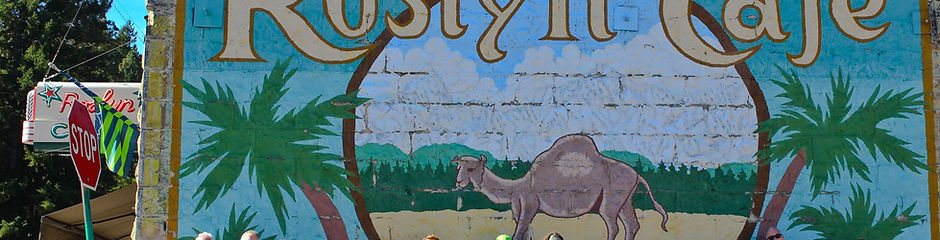
The fireweed is done. Six weeks, give or take. Late September brings the DJs, the ones who play this station from Ohio and Illinois and places farther off than that, who come up once a year to stand in front of the old Roslyn Café sign, take a photograph, and not say very much. They will be here soon. That sign has been faded so long that fading is now just its color. It has outlasted the café, the cook, the recipe, and most of the arguments about it, and it is still out there at the edge of town doing the only work a sign ever had, which is to stand there and mean something.
That's the news from Cicely, Alaska, where the light does what it wants, the road does what it can, and the people do the best they know how.
This is very nice, thank you for sharing.